
The crash diets vs. sustainable weight loss debate has a clear answer in the research, even if it is not the one most people want to hear. If your real goal is sustainable fat loss without crash dieting, the science has already settled the question. You have probably seen someone drop ten pounds in two weeks on a crash diet and thought that actually works. And it does. In the short term. The part that gets left out is what happens to the body during those two weeks and in the months that follow.
The science is remarkably consistent on this. It is not even a close debate among nutrition researchers. But because crash diets produce dramatic early results, and because dramatic results get attention, the cycle keeps repeating. People crash diet, lose weight fast, regain it, and conclude they just lacked willpower.
Willpower is rarely the problem. Biology is.
What Crash Diets Actually Do to Your Body
A crash diet typically involves severely cutting calories, often to below 800 per day, to force rapid weight loss. The scale does move fast. That part is real. But the weight being lost is not purely fat.
The Muscle Loss Problem
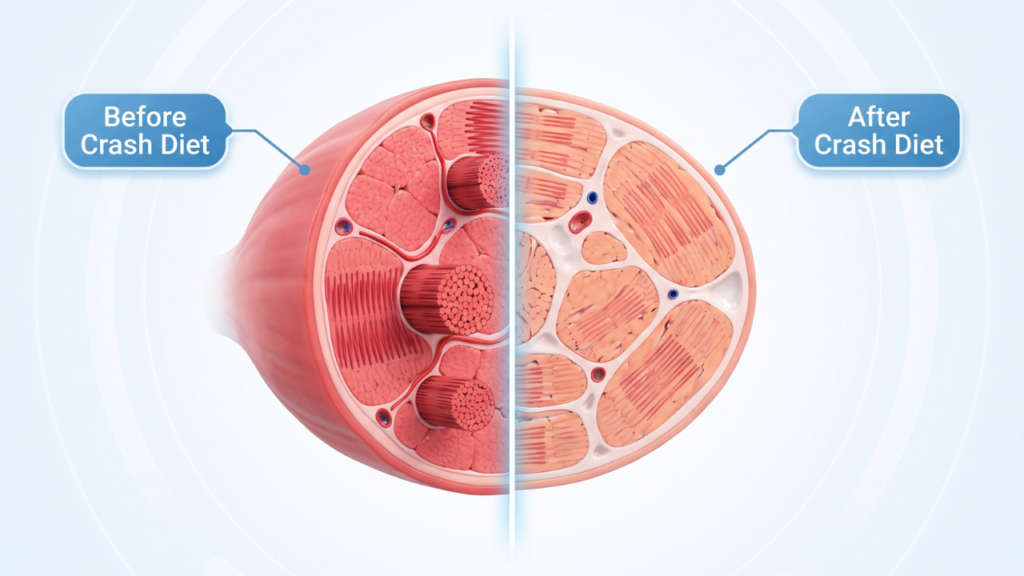
When calorie intake drops sharply, your body treats it as a threat. It shifts into conservation mode and begins burning muscle tissue alongside fat to meet its energy needs. Think of it like a real-world crash diet experiment: researchers tracking people who lost weight through extreme calorie restriction found that those who cut calories without adding resistance exercise lost roughly 2 percent of total lean mass and around 4 percent of leg muscle mass. Each 500-calorie daily reduction was predicted to result in approximately half a kilogram of leg muscle loss.
According to Harvard Health, crash diets and muscle loss go hand in hand because severe restriction gives the body no choice but to cannibalize lean tissue for fuel, which is one of the main reasons rapid weight loss tends to backfire. Muscle is metabolically active. It burns calories at rest. Lose it, and your body now burns fewer calories throughout the day, making future weight gain significantly easier.
This is one of the core reasons understanding why metabolism slows down with age matters for long-term weight management. Muscle loss from crash dieting accelerates the exact same metabolic decline that aging causes naturally.
The Hormonal Disruption Problem
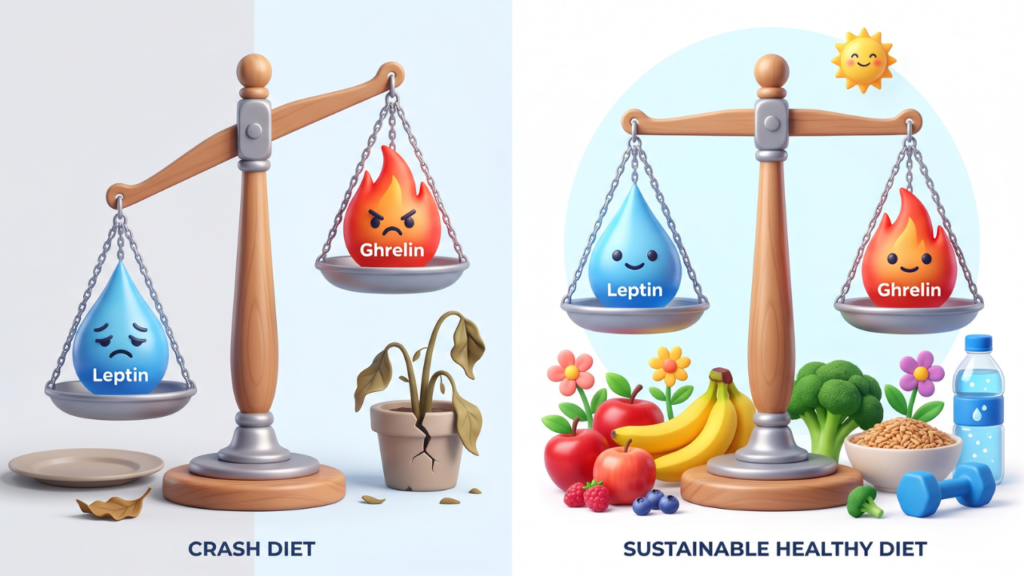
Crash dieting reshapes the hormones that control appetite in ways that outlast the diet itself. Leptin, the hormone that signals fullness to your brain, drops substantially during severe calorie restriction. Ghrelin, the hormone that drives hunger, rises. The result is a body that feels genuinely hungrier than it did before the diet started, even after the weight has come off.
What makes this especially frustrating is that these shifts are disproportionate to the fat lost. Your brain interprets a rapid drop in leptin as a sign of serious starvation, not just a diet, and responds by ramping up hunger signals accordingly. The body is not broken. It is doing exactly what it evolved to do when food becomes scarce.
The Metabolic Rate Drop
Studies on people who lost significant weight through extreme restriction found their resting metabolic rate was measurably lower than that of people of the same size who had never dieted. Mayo Clinic notes that crash diets are not sustainable precisely because severe restriction forces the body to break down muscle alongside fat, directly reducing how many calories you burn at rest. That gap compounds over months and years, quietly working against you long after the crash diet has ended.
Crash dieting can also reduce levels of the thyroid hormone T3, which regulates basal metabolic rate. Long-term changes in T3 contribute to slower metabolism and increased difficulty maintaining weight loss. These hormonal changes may persist for months or longer after the diet ends.
The Weight Regain Reality
The research on long-term outcomes after crash dieting is consistent. A study published in PubMed analyzing data from over 1,300 adults who had lost at least 10% of their body weight found that those who lost the greatest percentage of weight were significantly more likely to regain it. Losing more than 20 percent of maximum body weight was associated with nearly three times the odds of regaining compared to more moderate weight loss.
This is not a coincidence. It reflects the biological reality of how severe restriction affects metabolism, muscle mass, and appetite hormones. The body fights back. Hard. And it usually wins.

What Sustainable Weight Loss Actually Looks Like
Sustainable weight loss is not about eating less and suffering more. It is about creating a calorie deficit small enough that your body does not trigger its emergency conservation systems. Small enough that muscle is preserved. Small enough that hunger hormones stay manageable. But consistent enough, over enough time, that meaningful fat loss occurs.
The Numbers That Actually Work
According to Harvard Health, losing no more than 1 to 2 pounds per week yields more sustainable weight loss and helps preserve muscle. A starting deficit of around 500 calories per day is the standard recommendation, adjusted over time as your body changes. This pace feels slow. It is not dramatic. It does not make for compelling before-and-after photos at the two-week mark.
But it works in a way that rapid restriction does not, because it does not trigger the same cascade of metabolic and hormonal responses that make crash dieting so self-defeating.
What Actually Makes the Difference Long-Term
The research on people who lose weight and keep it off for years consistently points to the same behaviors. Regular physical activity, particularly a combination of aerobic exercise and resistance training. Consistent food tracking or at least awareness of intake. Eating patterns built around whole foods, adequate protein, and vegetables at most meals.
And critically, an approach flexible enough to survive real life without requiring perfect compliance every single day. None of that involves suffering. It involves building habits you can actually maintain.
How to Start the Sustainable Way

If you want to break the crash-diet cycle, here is where to start. Calculate your maintenance calories using a free online TDEE calculator. Subtract 300 to 500 calories from that number. Build meals around a palm-sized portion of protein, half a plate of vegetables, a fist of whole grains, and a thumb of healthy fat.
Aim for 7,000 to 10,000 steps per day as a baseline. Add two resistance training sessions per week to protect and build muscle. That framework will produce roughly half a pound to one pound of fat loss per week.
Over three months, that is six to twelve pounds. Over six months, twelve to twenty-four pounds. Unlike crash-diet results, those losses don’t come with a metabolically compromised body desperately trying to regain what it lost. The scale moves more slowly. Everything else works better..
Frequently Asked Questions
Very low-calorie diets below 800 calories per day are sometimes used medically under close supervision for people with obesity-related health emergencies. In those specific medical contexts, they can be appropriate. For the general population pursuing weight loss for health or appearance reasons, the risks outweigh the benefits when better alternatives exist.
The combination of reduced muscle mass, lowered resting metabolic rate, elevated ghrelin, and suppressed leptin creates conditions where weight regain is almost biologically inevitable once normal eating resumes. Your body is fighting back with every tool it has.
Visible changes typically become noticeable after four to six weeks of consistent effort. The scale will move more slowly than crash dieting, but the losses are predominantly fat rather than a mix of fat, muscle, and water weight.
Calorie balance is the primary driver of weight change, but food quality affects satiety, energy levels, muscle preservation, and long-term adherence. A deficit built around protein, fiber-rich vegetables, and whole foods is significantly easier to sustain than one built around processed low-calorie food.
Building muscle through resistance training is the most reliable way to raise resting metabolic rate. Adequate sleep, stress management, and sufficient protein intake also support metabolic health. There is no supplement or food that meaningfully raises resting metabolic rate beyond these fundamentals.
The Bottom Line
The research is not ambiguous. Crash diets trigger muscle loss, hormonal disruption, and metabolic slowdown that stack the deck against long-term success. Sustainable weight loss, built around a moderate deficit, adequate protein, and consistent movement, produces less dramatic short-term results and far better long-term ones.
Start with the 500-calorie deficit today. Build the resistance training habit this week. Give it three months before judging the results.